For a two-variable linear system, a non-zero coefficient determinant guarantees a unique solution.
Test for a Unique Solution
Write the coefficient matrix of the system.
Calculate its determinant.
det(A)=a1b2−a2b1
If the determinant is non-zero, the system has a unique solution.
det(A)=0
Worked example
Does the system 2x+4y=6, x+3y=5 have a unique solution?
Find the coefficient determinant for the system.
2143=2(3)−4(1)=2
Since it is non-zero, the system has a unique solution.
2=0
Answer: Yes. Its coefficient determinant is 2, which is non-zero.
Determinant of Order One
Order One
det([a])=a
Worked example
Evaluate det([7]).
The determinant equals the only entry.
det([7])=7
Answer:7
Determinant of Order Two
Order Two
a11a21a12a22=a11a22−a12a21
Worked example
Evaluate 2−142.
Apply the order-two formula.
2−142=2(2)−4(−1)
Simplify.
4+4=8
Answer:8
⚠ Common mistake
Do not add the diagonal products: the order-two rule is main-diagonal product minus off-diagonal product.
Determinant of Order Three
Expansion rule
For an entry in row i and column j, use sign (−1)i+j, delete its row and column to form the order-two determinant, and add the resulting terms. Expansion along any row or column gives the same value.
Area of a triangle using determinants — For vertices (x1,y1), (x2,y2) and (x3,y3), the triangle’s area is half the absolute value of their coordinate determinant.
Key properties
Positive area: Take the absolute value of the determinant.
Given area: Use both positive and negative determinant values when solving.
Collinear points: Three collinear points form a triangle of area 0.
Line test: A point (x,y) is on the line through two fixed points if the determinant for the three points is 0.
Use the determinant of the three coordinate rows; the expanded form is equivalent.
Finding a triangle’s area
Write the three vertices as rows with a final coordinate of 1.
x1x2x3y1y2y3111
Evaluate the determinant, take its absolute value, and divide by 2.
Δ=21∣D∣
Worked example
Find the area of the triangle with vertices (3,8), (−4,2) and (5,1).
Find the area for vertices (3,8), (−4,2) and (5,1).
Δ=213−45821111
Expand the determinant along the first row.
Δ=21∣3(2−1)−8(−4−5)+1(−4−10)∣
Simplify and take the absolute value.
Δ=21∣3+72−14∣=261
Answer: The area is 261 square units.
⚠ Common mistake
Do not report a negative area: take the absolute value of the determinant. If the area is given, retain both determinant signs while solving.
Practice
Use determinants to find the line through A(1,3) and B(0,0). If D(k,0) makes the area of △ABD equal to 3 square units, find k.
Hint: Set the determinant for the variable point (x,y) to 0 for the line; use the absolute value for the area.
Key step:21(y−3x)=0 and 21∣−3k∣=3.
Solution: The line is y=3x. Since ∣k∣=2, k=2 or k=−2.
Minors and Cofactors
Definition
Minor — The minor Mij of element aij is the determinant formed by deleting row i and column j.
Cofactors and determinant expansion
For an element aij, its cofactor is Aij=(−1)i+jMij. A determinant can be expanded along any one row or column by summing each entry times its corresponding cofactor.
Key properties
Order: In an order-n determinant, each minor is of order n−1.
Sign pattern: Cofactor signs alternate, starting with + at the top left.
Expansion along row i: Sum aijAij across that row.
Expansion along column j: Sum aijAij down that column.
Different row or column: Entries from one row (or column) multiplied by cofactors from a different row (or column) sum to 0.
For a fixed row or column, multiply each entry by its cofactor and add.
Zero sum using cofactors from a different row or column
For distinct rows r and s, ∑j=1narjAsj=0. For distinct columns r and s, ∑i=1nairAis=0.
Finding a minor and cofactor
Locate aij and delete its row and column to get Mij.
Mij
Evaluate the remaining determinant; for a 2×2 determinant, subtract the cross-products.
acbd=ad−bc
Multiply the minor by (−1)i+j to obtain the cofactor.
Aij=(−1)i+jMij
Worked example
Find the minors and cofactors of all elements of 1−243.
Find all minors and cofactors of the determinant.
Δ=1−243
Each minor is the single entry left after deleting the element’s row and column.
M11=3,M12=−2,M21=4,M22=1
Apply the alternating cofactor signs.
A11=3,A12=−(−2)=2,A21=−4,A22=1
Answer: The minors are M11=3, M12=−2, M21=4, M22=1; the cofactors are A11=3, A12=2, A21=−4, A22=1.
⚠ Common mistake
Do not confuse a minor with a cofactor: the cofactor includes the sign factor (−1)i+j.
Practice
Find the minor and cofactor of the element 6 in 147258369.
Hint: The element 6 is in row 2, column 3; delete that row and column.
Key step:M23=1728 and the cofactor sign is (−1)5.
Solution:M23=8−14=−6 and A23=(−1)5(−6)=6.
Practice
For Δ=261−30554−7, find all minors and cofactors, then verify a11A31+a12A32+a13A33=0.
Hint: Delete the matching row and column for each minor; use (−1)i+j to find each cofactor.
Key step: The third-row cofactors are A31=−12, A32=22, and A33=18.
Solution: Minors by row: (−20,−46,30), (−4,−19,13), (−12,−22,18). Cofactors by row: (−20,46,30), (4,−19,−13), (−12,22,18). The required sum is 2(−12)+(−3)(22)+5(18)=0.
Quick recap
Triangle area is half the absolute value of the coordinate determinant.
Three collinear points have determinant 0 and form a zero-area triangle.
A minor Mij is formed by deleting row i and column j.
A cofactor is Aij=(−1)i+jMij.
Expand a determinant along any one row or column using matching cofactors.
Entries from one row multiplied by cofactors from a different row sum to 0.
Write a linear system as AX=B, where A is the coefficient matrix, X is the variable vector and B is the constants vector. If ∣A∣=0, then A−1 exists and the system has the unique solution X=A−1B.
Singular coefficient matrix
If ∣A∣=0, then A−1 does not exist. For a square singular matrix, if (adjA)B=O, the system has no solution; if (adjA)B=O, it may have infinitely many solutions or no solution.
Inverse of a matrix and solution
A−1=∣A∣1adjA,X=A−1B(∣A∣=0)
Use these formulas when the coefficient matrix is nonsingular.
Solve a system using the inverse matrix
Arrange the equations as AX=B.
AX=B
Find ∣A∣. If it is nonzero, calculate A−1=∣A∣1adjA.
A−1=∣A∣1adjA
Calculate X=A−1B and read off the variable values.
X=A−1B
Worked example
Solve 3x−2y+3z=8, 2x+y−z=1 and 4x−3y+2z=4 using the matrix method.
Solve the system using the matrix method.
3x−2y+3z2x+y−z4x−3y+2z=8=1=4
Form AX=B and check that the coefficient matrix is nonsingular.
A=324−21−33−12,B=814,∣A∣=−17=0
Calculate the inverse using the adjugate.
A−1=−171−1−8−10−5−61−197
Multiply by B to obtain the variable vector.
X=A−1B=−171−17−34−51=123
Answer:x=1,y=2,z=3
⚠ Common mistake
Do not use A−1 when ∣A∣=0; the inverse exists only for a nonsingular matrix. Also check the sign of ∣A∣ when dividing the adjugate.
Practice
Solve 2x+5y=1 and 3x+2y=7 using the inverse-matrix method.
Hint: Use the coefficient matrix A=[2352].
Key step: Check ∣A∣=4−15=−11, then calculate A−1B.
Solution:A−1=−111[2−3−52], so [xy]=A−1[17]=[3−1]. Thus x=3,y=−1.
Practice
The sum of three numbers is 6. Three times the third number plus the second is 11, and the sum of the first and third is twice the second. Find the numbers using the matrix method.
Hint: Let the numbers be x,y,z in order and translate each condition into an equation.
Key step: The equations are x+y+z=6, y+3z=11 and x−2y+z=0; the coefficient determinant is 9.
Solution:A=10111−2131 and B=6110. Since ∣A∣=9, the system has a unique solution; A−1B=123. The numbers are 1,2,3.
Quick recap
A system is consistent if it has at least one solution; otherwise it is inconsistent.
This chapter's discussion is restricted to systems having unique solutions.
Write a linear system in the form AX=B.
If ∣A∣=0, then X=A−1B gives the unique solution.
For a nonsingular matrix, A−1=∣A∣1adjA.
If ∣A∣=0, the inverse method cannot be used; the system may have no solution or infinitely many solutions.
For a third-order determinant, the expansion shown is along the first row.
Cofactor Expansion and Adjugate Properties
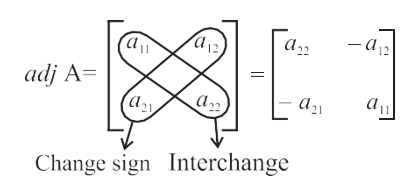
A determinant equals the sum of the products of entries in any row or column with their corresponding cofactors. For example, expansion along the first row gives ∣A∣=a11A11+a12A12+a13A13. The sum of entries of one row multiplied by the corresponding cofactors of a different row is zero, such as a11A21+a12A22+a13A23=0. The adjugate is the transpose of the cofactor matrix, and A(adjA)=(adjA)A=∣A∣I. A matrix is singular when ∣A∣=0 and non-singular when ∣A∣=0.
Triangle Area from Coordinates
Δ=21x1x2x3y1y2y3111
Use the absolute value of the determinant; the third row contains the third vertex coordinates.
Inverse Matrix and Matrix Equation
A−1=∣A∣1adjA(∣A∣=0),AX=B⟹X=A−1B
A square matrix has an inverse exactly when it is non-singular. If AB=BA=I, then B=A−1 and (A−1)−1=A.
Solutions of a Square Matrix System
For AX=B, a non-singular coefficient matrix gives exactly one solution. If ∣A∣=0, then (adjA)B=0 implies no solution; if (adjA)B=0, the system may or may not be consistent. A system is consistent if at least one solution exists, and inconsistent if none exists.
Solve a Linear System Using the Inverse
Write the system as AX=B, where A contains the coefficients and X contains the variables.
AX=B
Check that ∣A∣=0 so the inverse exists.
∣A∣=0
Find A−1 and calculate X=A−1B.
X=A−1B
Read the values of the variables from the resulting vector.
Worked example
Solve x−y+2z=1, 2y−3z=1, and 3x−2y+4z=2 using the inverse-matrix method.
Write the system in matrix form.
103−12−22−34xyz=112
The coefficient determinant is non-zero, so the inverse exists.
∣A∣=−1
Use the inverse matrix and verify that it gives the identity when multiplied by A.
A−1=−2960211−3−2,AA−1=I
Multiply the inverse by the constants vector.
xyz=A−1B=−2960211−3−2112=053
Answer:x=0,y=5,z=3.
⚠ Common mistake
Do not use A−1=∣A∣1adjA when ∣A∣=0; a singular matrix has no inverse. For coordinate-area questions, use the absolute value of the determinant.
Practice
Find 102210011.
Hint: Expand along the first row.
Key step:1(1)−2(−2)+0=5.
Solution: The determinant is 5.
Practice
Find the area of the triangle with vertices (0,0), (4,0) and (1,3).
Hint: Use the coordinate determinant area formula.
Key step:Δ=21∣12∣.
Solution: The area is 6 square units.
Practice
Classify the solutions of x+y=1 and 2x+2y=2.
Hint: Check whether the second equation is a multiple of the first.
Key step: The second equation is twice the first, so both represent the same line.
Solution: The system is consistent and has infinitely many solutions: x+y=1.
Quick recap
Expand a determinant using entries and their matching cofactors.
The cofactor is Aij=(−1)i+jMij; the adjugate is the transpose of the cofactor matrix.
A matrix is invertible exactly when its determinant is non-zero.
For AX=B with ∣A∣=0, the unique solution is X=A−1B.
For triangle vertices, the area is one-half the absolute value of the coordinate determinant.
When ∣A∣=0, use the adjugate consistency test carefully: a zero result does not alone guarantee consistency.