Class 12 PCM . Mathematics . Mathematics Part I . Matrices
Chapter 3: Matrices
Ch 3
Mathematics
Class 12 PCM
Matrices and Operations
A matrix is an ordered rectangular array of numbers or functions arranged in rows and columns. It is denoted by uppercase letters such as . A matrix of order has rows and columns, with elements where is the row number and is the column number.
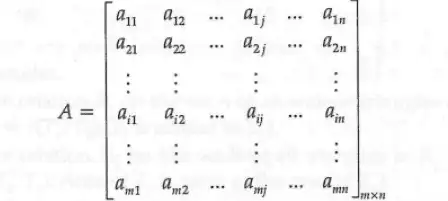
The elements are arranged as:
Types of Matrices
- Column matrix: A matrix with only one column, order .
- Row matrix: A matrix with only one row, order .
- Square matrix: Number of rows equals number of columns, order .
- Diagonal matrix: Square matrix where all off-diagonal elements are zero, i.e., for .
- Scalar matrix: Diagonal matrix with all diagonal elements equal to a constant , i.e., if , else 0.
- Identity matrix: Scalar matrix with , denoted by , where if , else 0.
- Zero matrix: All elements are zero.
- Horizontal matrix: Matrix with more columns than rows, \( m < n \).
- Vertical matrix: Matrix with more rows than columns, \( m > n \).
Equality of Matrices
Two matrices and of the same order are equal if and only if for all .
Addition of Matrices
If and are matrices of order , their sum is also a matrix of order . Addition is defined only if matrices have the same order.
Multiplication of a Matrix by a Scalar
For a scalar and matrix , the product is obtained by multiplying each element of by .
Multiplication of Two Matrices
Let be an matrix and be an matrix. The product is an matrix where
Matrix multiplication is defined only if the number of columns of equals the number of rows of . Note that matrix multiplication is not commutative.
Properties of Matrix Multiplication
- If is and is , then is .
- If and are square matrices of order , and is the identity matrix, then .
Idempotent Matrix
A square matrix is idempotent if .
Transpose of a Matrix
The transpose of an matrix is the matrix obtained by interchanging rows and columns.
Properties of Transpose
- , where is a scalar
Worked Examples
Example 1
Problem: Find all possible orders of a matrix with 8 elements.
Solution: If a matrix has order , then . The possible pairs are (1,8), (8,1), (2,4), (4,2). Hence, possible orders are .
Example 2
Problem: Construct a matrix where .
Solution:
Thus,
Example 3
Problem: Multiply matrices
Solution: Since is and is , multiplication is defined and will be .
Example 4
Problem: Verify the matrix identity for given matrices and .
Solution: Calculate , then . Calculate and , then multiply . Verify both results are equal.
Practice Set
Level 1 – Easy
- Find the order of a matrix with 12 elements.
- Write a zero matrix.
- Add two matrices and .
Level 2 – Moderate
- Multiply matrix by scalar 3.
- Find the product of and .
- Find the transpose of .
Level 3 – Challenging
- Given , find and verify if is idempotent.
- Find the product where and .
- Verify the property for matrices of appropriate orders.
Answer Key
Level 1
- Possible orders for 12 elements: (1,12), (12,1), (2,6), (6,2), (3,4), (4,3).
- Zero matrix : .
- Sum: .
Level 2
- Scalar multiplication: .
- Product: .
- Transpose: .
Level 3
- , so , not idempotent.
- .
- Verification requires matrix multiplication and transpose; results will be equal.
Quick Reference
| Operation | Formula | Condition |
|---|---|---|
| Addition | Same order matrices | |
| Scalar Multiplication | Any matrix | |
| Matrix Multiplication | Columns of A = Rows of B | |
| Transpose | Any matrix | |
| Idempotent | Square matrix |
Glossary
- Matrix: Rectangular array of elements arranged in rows and columns.
- Order: Number of rows and columns of a matrix, denoted .
- Element: Individual entry in a matrix, denoted .
- Scalar: A single number used to multiply a matrix.
- Transpose: Matrix obtained by interchanging rows and columns.
- Idempotent matrix: Matrix satisfying .
Symmetric, Skew-Symmetric and Invertible Matrices
A square matrix is:
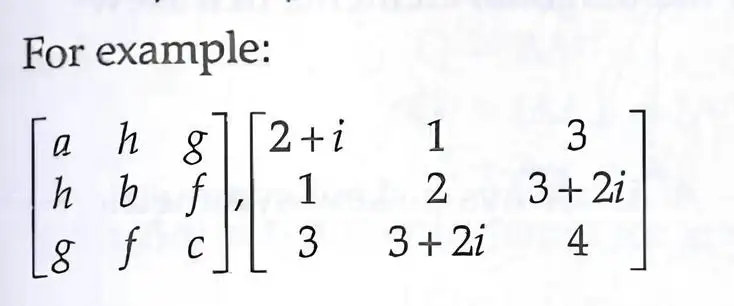
Symmetric Matrix
If , i.e., for all .
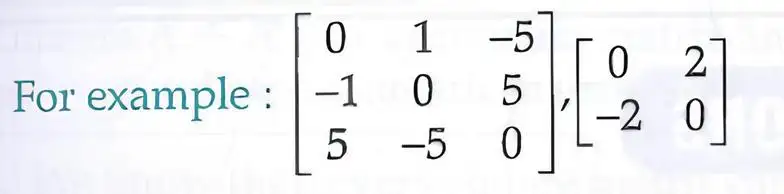
Skew-Symmetric Matrix
If , i.e., and all diagonal elements .
Orthogonal Matrix
A matrix is orthogonal if , where is the identity matrix.
Invertible Matrix
A square matrix is invertible if there exists a matrix such that , where is the identity matrix.
Worked Examples
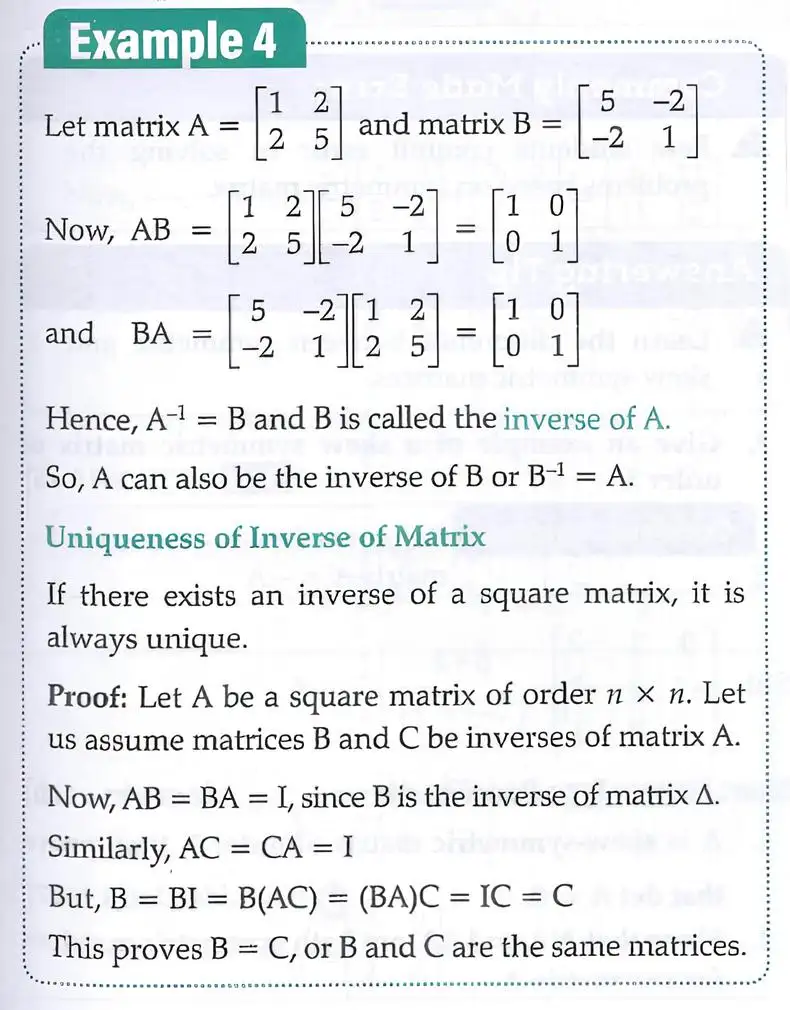
Example 4
Problem: Show that the inverse of a matrix, if it exists, is unique.
Solution: Given matrices and such that , is the inverse of . If another matrix also satisfies , then , proving uniqueness.
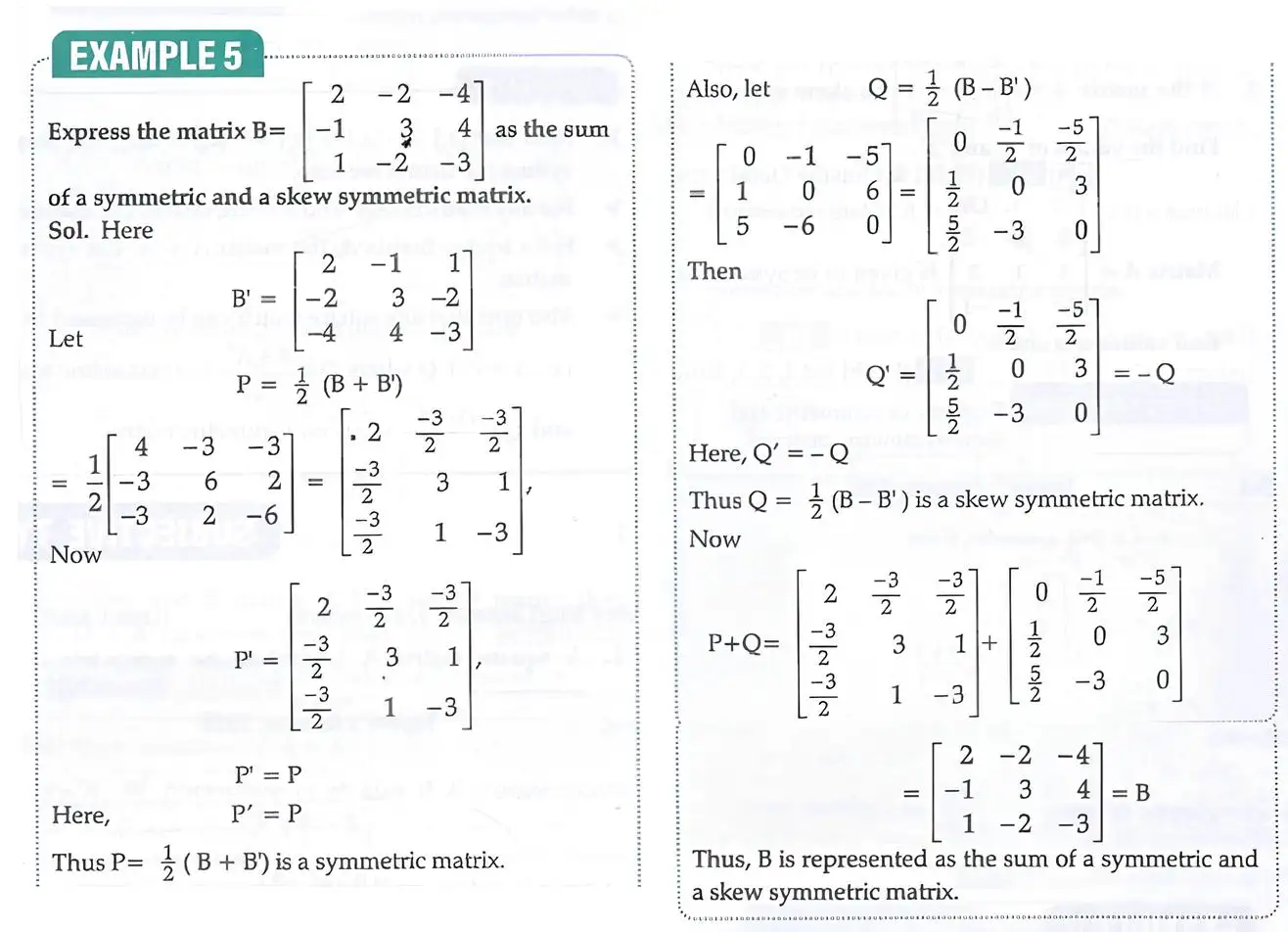
Example 5
Problem: Express matrix as the sum of a symmetric matrix and a skew-symmetric matrix .
Solution:
Calculate , then and accordingly.
Key Facts
- Diagonal elements of a skew-symmetric matrix are zero.
- For any matrix , and are symmetric.
- Any square matrix can be expressed as , where is symmetric and is skew-symmetric.
Glossary
- Symmetric matrix: Matrix equal to its transpose.
- Skew-symmetric matrix: Matrix whose transpose equals its negative.
- Orthogonal matrix: Matrix whose product with its transpose is the identity matrix.
- Invertible matrix: Matrix having a unique inverse such that their product is the identity matrix.
Mathematics — ALL CHAPTERS
1
Relations And Functions
2
Inverse Trigonometric Functions
3
Matrices
4
DETERMINANTS
5
Continuity And Differentiability
6
Application Of Derivatives
7
Integrals
8
APPLICATION OF INTEGRALS
9
DIFFERENTIAL EQUATIONS
10
VECTOR ALGEBRA
11
Three Dimensional Geometry
12
Linear Programming
13
Probability
14
Proofs In Mathematics
15
Mathematical Modelling