Class 12 PCM . Mathematics . Mathematics Part II . Vector Algebra

Chapter 10: VECTOR ALGEBRA

Ch 10

Mathematics

Class 12 PCM

Basic Algebra of Vectors

A vector is a physical quantity having both magnitude and direction, denoted as A⃗,B⃗,a⃗\vec{A}, \vec{B}, \vec{a}. The magnitude of a vector a⃗\vec{a} is denoted by ∣a⃗∣|\vec{a}|.

Initial and Terminal Points: The initial point is where the vector originates, and the terminal point is where it ends.

Position Vector: For a point P(x,y,z)P(x,y,z), the position vector is OP⃗=r⃗=xi^+yj^+zk^\vec{OP} = \vec{r} = x\hat{i} + y\hat{j} + z\hat{k} with magnitude ∣r⃗∣=x2+y2+z2|\vec{r}| = \sqrt{x^2 + y^2 + z^2}.

For points A(x1,y1,z1)A(x_1,y_1,z_1) and B(x2,y2,z2)B(x_2,y_2,z_2), the vector AB⃗=(x2−x1)i^+(y2−y1)j^+(z2−z1)k^\vec{AB} = (x_2 - x_1)\hat{i} + (y_2 - y_1)\hat{j} + (z_2 - z_1)\hat{k}.

Example 1

Given a⃗=i^+2j^\vec{a} = \hat{i} + 2\hat{j} and b⃗=2i^+j^\vec{b} = 2\hat{i} + \hat{j}, check if a⃗=b⃗\vec{a} = \vec{b}.

Solution: Since components differ, a⃗≠b⃗\vec{a} \neq \vec{b}.

Addition of Vectors

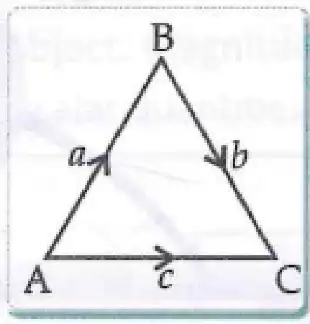
Triangular Law: If AB⃗=a⃗\vec{AB} = \vec{a} and BC⃗=b⃗\vec{BC} = \vec{b}, then AC⃗=a⃗+b⃗\vec{AC} = \vec{a} + \vec{b}. Also, AB⃗+BC⃗+CA⃗=0⃗\vec{AB} + \vec{BC} + \vec{CA} = \vec{0}.

Diagram 1 – CBSE Class 12 PCM Mathematics VECTOR ALGEBRA

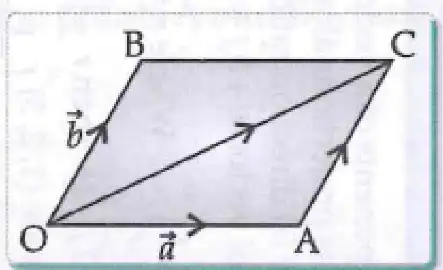
Parallelogram Law: If a⃗\vec{a} and b⃗\vec{b} are adjacent sides of parallelogram OACBOACB, then OC⃗=a⃗+b⃗\vec{OC} = \vec{a} + \vec{b}.

Diagram 2 – CBSE Class 12 PCM Mathematics VECTOR ALGEBRA

Multiplication of a Vector by a Scalar

For scalar kk and vector a⃗\vec{a}, ka⃗k\vec{a} has magnitude ∣k∣∣a⃗∣angle|k||\vec{a}| angle and direction same as a⃗\vec{a} if \(k>0\), opposite if \(k<0\).

Diagram 3 – CBSE Class 12 PCM Mathematics VECTOR ALGEBRA

Types of Vectors

  • Zero Vector: Initial and terminal points coincide, magnitude zero.
  • Co-initial Vectors: Vectors with the same initial point.
  • Co-terminus Vectors: Vectors with the same terminal point.
  • Negative Vector: Same magnitude, opposite direction, denoted −r⃗-\vec{r}.
  • Unit Vector: Vector with magnitude 1, r^=r⃗∣r⃗∣\hat{r} = \frac{\vec{r}}{|\vec{r}|}.
  • Reciprocal Vector: Same direction as r⃗\vec{r}, magnitude 1∣r⃗∣\frac{1}{|\vec{r}|}, denoted r⃗−1\vec{r}^{-1}.
  • Equal Vectors: Same magnitude and direction.
  • Collinear Vectors: Parallel vectors, a⃗=λb⃗\vec{a} = \lambda \vec{b} for scalar λ\lambda.
  • Free Vectors: Vectors that can be moved parallel without changing magnitude or direction.

Properties of Vectors

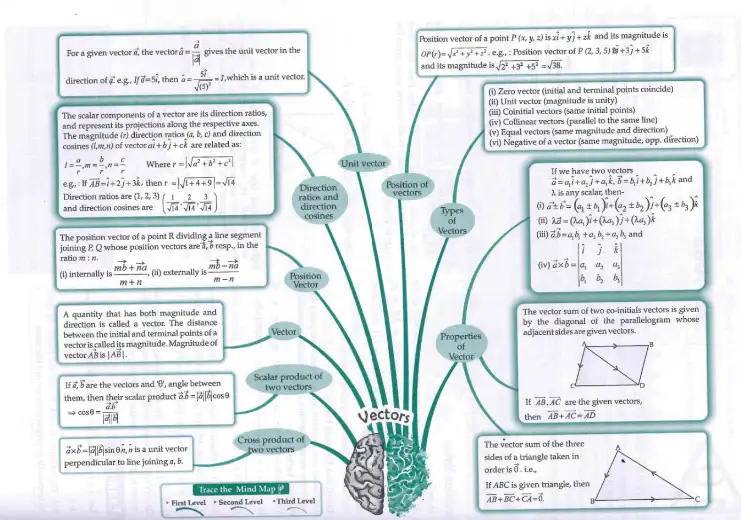
The sum of vectors around a triangle is zero: AB⃗+BC⃗+CA⃗=0⃗\vec{AB} + \vec{BC} + \vec{CA} = \vec{0}.

Key Formulae

Position vector of point PP dividing segment ABAB in ratio m:nm:n:

  • Internally: OP⃗=mb⃗+na⃗m+n\vec{OP} = \frac{m\vec{b} + n\vec{a}}{m+n}
  • Externally: OP⃗=mb⃗−na⃗m−n\vec{OP} = \frac{m\vec{b} - n\vec{a}}{m-n}
  • If PP is midpoint, OP⃗=a⃗+b⃗2\vec{OP} = \frac{\vec{a} + \vec{b}}{2}

Practice Set

  • Level 1: Find the magnitude of a⃗=3i^+4j^\vec{a} = 3\hat{i} + 4\hat{j}.
  • Level 2: Given a⃗=2i^+3j^+k^\vec{a} = 2\hat{i} + 3\hat{j} + \hat{k} and b⃗=i^+2j^+4k^\vec{b} = \hat{i} + 2\hat{j} + 4\hat{k}, find AB⃗\vec{AB} where AA and BB have position vectors a⃗\vec{a} and b⃗\vec{b}.
  • Level 3: Prove that the sum of vectors around a triangle is zero.

Answer Key

  • Level 1: ∣a⃗∣=32+42=5|\vec{a}| = \sqrt{3^2 + 4^2} = 5
  • Level 2: AB⃗=b⃗−a⃗=(−1)i^−1j^+3k^\vec{AB} = \vec{b} - \vec{a} = (-1)\hat{i} - 1\hat{j} + 3\hat{k}
  • Level 3: Using triangle law, AB⃗+BC⃗+CA⃗=0⃗\vec{AB} + \vec{BC} + \vec{CA} = \vec{0} by vector addition.

Quick Reference

ConceptFormula
Position Vectorr⃗=xi^+yj^+zk^\vec{r} = x\hat{i} + y\hat{j} + z\hat{k}
Vector between pointsAB⃗=b⃗−a⃗\vec{AB} = \vec{b} - \vec{a}
Midpointa⃗+b⃗2\frac{\vec{a} + \vec{b}}{2}

Glossary

  • Vector: Quantity with magnitude and direction.
  • Magnitude: Length of a vector.
  • Unit Vector: Vector of length 1.
  • Scalar: A real number.
  • Position Vector: Vector from origin to a point.

Dot Product of Vector

The dot product (scalar product) of vectors a⃗\vec{a} and b⃗\vec{b} is defined as:

a⃗⋅b⃗=∣a⃗∣∣b⃗∣cos⁡θ\vec{a} \cdot \vec{b} = |\vec{a}| |\vec{b}| \cos \theta

where θ\theta is the angle between a⃗\vec{a} and b⃗\vec{b}, 0≤θ≤π0 \leq \theta \leq \pi.

For a⃗=a1i^+a2j^+a3k^\vec{a} = a_1 \hat{i} + a_2 \hat{j} + a_3 \hat{k} and b⃗=b1i^+b2j^+b3k^\vec{b} = b_1 \hat{i} + b_2 \hat{j} + b_3 \hat{k},

a⃗⋅b⃗=a1b1+a2b2+a3b3\vec{a} \cdot \vec{b} = a_1 b_1 + a_2 b_2 + a_3 b_3

Projection of a Vector

Projection of a⃗\vec{a} on b⃗\vec{b}:

projb⃗a⃗=a⃗⋅b⃗∣b⃗∣\text{proj}_{\vec{b}} \vec{a} = \frac{\vec{a} \cdot \vec{b}}{|\vec{b}|}

Projection of b⃗\vec{b} on a⃗\vec{a}:

proja⃗b⃗=a⃗⋅b⃗∣a⃗∣\text{proj}_{\vec{a}} \vec{b} = \frac{\vec{a} \cdot \vec{b}}{|\vec{a}|}

Example 2

Find the projection of a⃗=2i^+3j^+2k^\vec{a} = 2\hat{i} + 3\hat{j} + 2\hat{k} on b⃗=i^+2j^+k^\vec{b} = \hat{i} + 2\hat{j} + \hat{k}.

Solution:

a⃗⋅b⃗=2×1+3×2+2×1=2+6+2=10\vec{a} \cdot \vec{b} = 2 \times 1 + 3 \times 2 + 2 \times 1 = 2 + 6 + 2 = 10

∣b⃗∣=12+22+12=6|\vec{b}| = \sqrt{1^2 + 2^2 + 1^2} = \sqrt{6}

Projection = 106=563\frac{10}{\sqrt{6}} = \frac{5 \sqrt{6}}{3}

Properties of Dot Product

  • i^⋅i^=1\hat{i} \cdot \hat{i} = 1, i^⋅j^=0\hat{i} \cdot \hat{j} = 0
  • Dot product is commutative: a⃗⋅b⃗=b⃗⋅a⃗\vec{a} \cdot \vec{b} = \vec{b} \cdot \vec{a}
  • a⃗⋅b⃗=0\vec{a} \cdot \vec{b} = 0 if vectors are perpendicular or one is zero vector.
  • Distributive: a⃗⋅(b⃗+c⃗)=a⃗⋅b⃗+a⃗⋅c⃗\vec{a} \cdot (\vec{b} + \vec{c}) = \vec{a} \cdot \vec{b} + \vec{a} \cdot \vec{c}

Key Formula

Angle between two vectors:

cos⁡θ=a⃗⋅b⃗∣a⃗∣∣b⃗∣⇒θ=cos⁡−1(a⃗⋅b⃗∣a⃗∣∣b⃗∣)\cos \theta = \frac{\vec{a} \cdot \vec{b}}{|\vec{a}| |\vec{b}|} \quad \Rightarrow \quad \theta = \cos^{-1} \left( \frac{\vec{a} \cdot \vec{b}}{|\vec{a}| |\vec{b}|} \right)

Practice Set

  • Level 1: Find a⃗⋅b⃗\vec{a} \cdot \vec{b} for a⃗=i^+2j^\vec{a} = \hat{i} + 2\hat{j}, b⃗=3i^+j^\vec{b} = 3\hat{i} + \hat{j}.
  • Level 2: Find the angle between a⃗=2i^+3j^+k^\vec{a} = 2\hat{i} + 3\hat{j} + \hat{k} and b⃗=i^+2j^+2k^\vec{b} = \hat{i} + 2\hat{j} + 2\hat{k}.
  • Level 3: Prove that if a⃗⋅b⃗=0\vec{a} \cdot \vec{b} = 0, then a⃗\vec{a} and b⃗\vec{b} are perpendicular.

Answer Key

  • Level 1: a⃗⋅b⃗=1×3+2×1=5\vec{a} \cdot \vec{b} = 1 \times 3 + 2 \times 1 = 5
  • Level 2: cos⁡θ=2×1+3×2+1×24+9+11+4+4=2+6+2149=10314\cos \theta = \frac{2 \times 1 + 3 \times 2 + 1 \times 2}{\sqrt{4+9+1} \sqrt{1+4+4}} = \frac{2 + 6 + 2}{\sqrt{14} \sqrt{9}} = \frac{10}{3\sqrt{14}}
  • Level 3: By definition, a⃗⋅b⃗=∣a⃗∣∣b⃗∣cos⁡θ=0\vec{a} \cdot \vec{b} = |\vec{a}||\vec{b}| \cos \theta = 0 implies cos⁡θ=0\cos \theta = 0, so θ=90∘\theta = 90^\circ.

Quick Reference

ConceptFormula
Dot Producta⃗⋅b⃗=a1b1+a2b2+a3b3\vec{a} \cdot \vec{b} = a_1 b_1 + a_2 b_2 + a_3 b_3
Projection of a⃗\vec{a} on b⃗\vec{b}a⃗⋅b⃗∣b⃗∣\frac{\vec{a} \cdot \vec{b}}{|\vec{b}|}
Angle between vectorscos⁡θ=a⃗⋅b⃗∣a⃗∣∣b⃗∣\cos \theta = \frac{\vec{a} \cdot \vec{b}}{|\vec{a}| |\vec{b}|}

Glossary

  • Dot Product: Scalar product of two vectors.
  • Projection: Shadow or component of one vector on another.
  • Angle between vectors: The angle formed by two vectors.

Cross Product

The cross product (vector product) of vectors a⃗\vec{a} and b⃗\vec{b} is defined as:

a⃗×b⃗=∣a⃗∣∣b⃗∣sin⁡θn^\vec{a} \times \vec{b} = |\vec{a}| |\vec{b}| \sin \theta \hat{n}

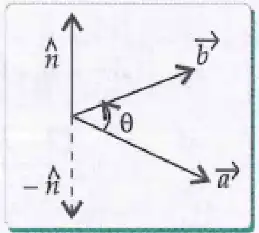
where θ\theta is the angle between a⃗\vec{a} and b⃗\vec{b}, and n^\hat{n} is a unit vector perpendicular to both a⃗\vec{a} and b⃗\vec{b} following the right-hand rule.

For a⃗=a1i^+a2j^+a3k^\vec{a} = a_1 \hat{i} + a_2 \hat{j} + a_3 \hat{k} and b⃗=b1i^+b2j^+b3k^\vec{b} = b_1 \hat{i} + b_2 \hat{j} + b_3 \hat{k},

a⃗×b⃗=∣i^j^k^a1a2a3b1b2b3∣=(a2b3−a3b2)i^−(a1b3−a3b1)j^+(a1b2−a2b1)k^\vec{a} \times \vec{b} = \begin{vmatrix} \hat{i} & \hat{j} & \hat{k} \\ a_1 & a_2 & a_3 \\ b_1 & b_2 & b_3 \end{vmatrix} = (a_2 b_3 - a_3 b_2) \hat{i} - (a_1 b_3 - a_3 b_1) \hat{j} + (a_1 b_2 - a_2 b_1) \hat{k}

Diagram 4 – CBSE Class 12 PCM Mathematics VECTOR ALGEBRA

Properties of Cross Product

  • i^×i^=0⃗\hat{i} \times \hat{i} = \vec{0}, similarly for j^\hat{j} and k^\hat{k}.
  • i^×j^=k^\hat{i} \times \hat{j} = \hat{k}, j^×k^=i^\hat{j} \times \hat{k} = \hat{i}, k^×i^=j^\hat{k} \times \hat{i} = \hat{j}.
  • a⃗×b⃗=0⃗\vec{a} \times \vec{b} = \vec{0} if a⃗\vec{a} and b⃗\vec{b} are parallel or zero vectors.
  • Cross product is not commutative: a⃗×b⃗=−(b⃗×a⃗)\vec{a} \times \vec{b} = - (\vec{b} \times \vec{a}).
  • Distributive over addition: a⃗×(b⃗+c⃗)=a⃗×b⃗+a⃗×c⃗\vec{a} \times (\vec{b} + \vec{c}) = \vec{a} \times \vec{b} + \vec{a} \times \vec{c}.

Relationship Between Vector and Scalar Products (Lagrange's Identity)

∣a⃗×b⃗∣2+(a⃗⋅b⃗)2=∣a⃗∣2∣b⃗∣2|\vec{a} \times \vec{b}|^2 + (\vec{a} \cdot \vec{b})^2 = |\vec{a}|^2 |\vec{b}|^2

Cauchy-Schwarz Inequality

For any vectors a⃗\vec{a} and b⃗\vec{b},

∣a⃗⋅b⃗∣≤∣a⃗∣∣b⃗∣|\vec{a} \cdot \vec{b}| \leq |\vec{a}| |\vec{b}|

Applications

  • Area of triangle with adjacent sides a⃗\vec{a} and b⃗\vec{b}: 12∣a⃗×b⃗∣\frac{1}{2} |\vec{a} \times \vec{b}|
  • Area of parallelogram with adjacent sides a⃗\vec{a} and b⃗\vec{b}: ∣a⃗×b⃗∣|\vec{a} \times \vec{b}|

Practice Set

  • Level 1: Compute i^×j^\hat{i} \times \hat{j}.
  • Level 2: Find a⃗×b⃗\vec{a} \times \vec{b} for a⃗=i^+2j^+3k^\vec{a} = \hat{i} + 2\hat{j} + 3\hat{k}, b⃗=4i^+5j^+6k^\vec{b} = 4\hat{i} + 5\hat{j} + 6\hat{k}.
  • Level 3: Prove Lagrange's identity for vectors a⃗\vec{a} and b⃗\vec{b}.

Answer Key

  • Level 1: i^×j^=k^\hat{i} \times \hat{j} = \hat{k}
  • Level 2: a⃗×b⃗=(−3)i^+6j^−3k^\vec{a} \times \vec{b} = (-3)\hat{i} + 6\hat{j} - 3\hat{k}
  • Level 3: Use vector algebra to expand ∣a⃗×b⃗∣2+(a⃗⋅b⃗)2|\vec{a} \times \vec{b}|^2 + (\vec{a} \cdot \vec{b})^2 and show it equals ∣a⃗∣2∣b⃗∣2|\vec{a}|^2 |\vec{b}|^2.

Quick Reference

ConceptFormula
Cross Producta⃗×b⃗=∣i^j^k^a1a2a3b1b2b3∣\vec{a} \times \vec{b} = \begin{vmatrix} \hat{i} & \hat{j} & \hat{k} \\ a_1 & a_2 & a_3 \\ b_1 & b_2 & b_3 \end{vmatrix}
Area of Triangle12∣a⃗×b⃗∣\frac{1}{2} |\vec{a} \times \vec{b}|
Lagrange's Identity∣a⃗×b⃗∣2+(a⃗⋅b⃗)2=∣a⃗∣2∣b⃗∣2|\vec{a} \times \vec{b}|^2 + (\vec{a} \cdot \vec{b})^2 = |\vec{a}|^2 |\vec{b}|^2

Glossary

  • Cross Product: Vector perpendicular to two given vectors.
  • Unit Vector: Vector of length 1.
  • Lagrange's Identity: Relation between dot and cross products.
  • Cauchy-Schwarz Inequality: Bound on dot product magnitude.

Mathematics — ALL CHAPTERS

1

Relations And Functions

View

2

Inverse Trigonometric Functions

View

3

Matrices

View

4

DETERMINANTS 

View

5

Continuity And Differentiability

View

6

Application Of Derivatives

View

7

Integrals

View

8

APPLICATION OF INTEGRALS

View

9

DIFFERENTIAL EQUATIONS

View

10

VECTOR ALGEBRA

View

11

Three Dimensional Geometry

View

12

Linear Programming

View

13

Probability

View

14

Proofs In Mathematics

View

15

Mathematical Modelling

View
Vector Algebra Notes – Class 12 Mathematics | Prepzy