Class 10 . Mathematics . Mathematics . Areas Related to Circles

Chapter 11: Areas Related To Circles

Ch 11

Mathematics

Class 10

Lecture 1

Areas Of Sector And Segment Of A Circle

Reference video · Lecture 1Areas Of Sector And Segment Of A Circle

Sectors and Arc Length

Definition

Sector — A sector is the part of a circle enclosed by two radii and the arc between them.
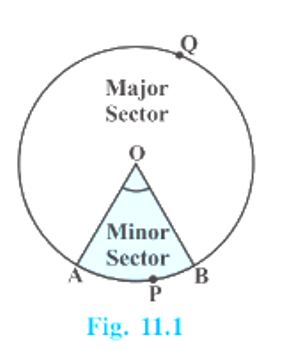
Minor and major sectors of a circle.

Sector facts

  • Minor sector: The smaller sector; its central angle is usually denoted by θ\theta.
  • Major sector: The remaining, larger sector; its central angle is 360∘−θ360^\circ-\theta.
  • Convention: Unless stated otherwise, “sector” means the minor sector.
Area and arc length of a sector

A sector with radius rr and central angle θ\theta (in degrees) is the fraction θ360∘\frac{\theta}{360^\circ} of the whole circle.

Sector area
A=θ360∘πr2A=\frac{\theta}{360^\circ}\pi r^2

Use when the radius and central angle in degrees are known.

Arc length
l=θ360∘ 2πrl=\frac{\theta}{360^\circ}\,2\pi r

The arc length is the same fraction of the circle’s circumference.

Major sector area
Amajor=πr2−Aminor=360∘−θ360∘πr2A_{\text{major}}=\pi r^2-A_{\text{minor}}=\frac{360^\circ-\theta}{360^\circ}\pi r^2

The major sector and minor sector together make one full circle.

Finding sector area and arc length

  1. Identify the radius and central angle in degrees.
  2. Substitute into the sector-area or arc-length formula.
    A=θ360∘πr2,l=θ360∘ 2πrA=\frac{\theta}{360^\circ}\pi r^2,\qquad l=\frac{\theta}{360^\circ}\,2\pi r
  3. For a major sector, use the remaining angle or subtract the minor-sector area from the circle’s area.
Worked example

Find the areas of the minor and major sectors.

  1. Find the minor and major sector areas for radius 44 cm and angle 30∘30^\circ, using π=3.14\pi=3.14.
  2. Calculate the minor-sector area.
    Aminor=30360×3.14×42=12.563≈4.19 cm2A_{\text{minor}}=\frac{30}{360}\times 3.14\times 4^2=\frac{12.56}{3}\approx 4.19\text{ cm}^2
  3. Subtract it from the area of the full circle to get the major-sector area.
    Amajor=3.14×42−4.19=46.05≈46.1 cm2A_{\text{major}}=3.14\times 4^2-4.19=46.05\approx 46.1\text{ cm}^2
Answer: Minor sector: approximately 4.19 cm24.19\text{ cm}^2; major sector: approximately 46.1 cm246.1\text{ cm}^2.
⚠ Common mistake

Do not use the sector-area formula for arc length: area uses πr2\pi r^2, while arc length uses the circumference 2πr2\pi r.

Segments of a Circle

Definition

Segment — A segment is the part of a circle enclosed by a chord and its corresponding arc.
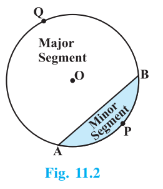
A chord divides a circle into a minor segment and a major segment.

Segment facts

  • Minor segment: The smaller region between a chord and its minor arc; by default, “segment” means the minor segment.
  • Major segment: The larger region on the other side of the chord.
  • Complement: Major segment area equals the circle’s area minus the minor segment area.
Area of a segment

The area of a segment equals the area of its corresponding sector minus the area of the triangle formed by the two radii and the chord.

Aminor segment=Asector−A△A_{\text{minor segment}}=A_{\text{sector}}-A_{\triangle}
Major segment area
Amajor segment=πr2−Aminor segmentA_{\text{major segment}}=\pi r^2-A_{\text{minor segment}}

Use the full-circle area to find the complementary major segment.

Finding a segment area

  1. Find the corresponding sector area using its central angle.
    Asector=θ360∘πr2A_{\text{sector}}=\frac{\theta}{360^\circ}\pi r^2
  2. Find the area of the triangle inside that sector.
    A△=12×base×heightA_{\triangle}=\frac{1}{2}\times\text{base}\times\text{height}
  3. Subtract the triangle area from the sector area.
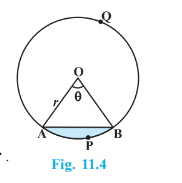
    Asegment=Asector−A△A_{\text{segment}}=A_{\text{sector}}-A_{\triangle}
The minor segment is the sector minus the triangle formed by the radii and chord.
Worked example

Find the area of the minor segment cut off by a chord subtending 120∘120^\circ at the centre of a circle of radius 2121 cm.

  1. Find the minor segment area when r=21r=21 cm and ∠AOB=120∘\angle AOB=120^\circ, using π=227\pi=\frac{22}{7}.
  2. Calculate the sector area.
    Asector=120360×227×212=462 cm2A_{\text{sector}}=\frac{120}{360}\times\frac{22}{7}\times 21^2=462\text{ cm}^2
  3. Drop a perpendicular from OO to chord ABAB at MM. Since OA=OBOA=OB, MM bisects ABAB and the central angle.
    ∠AOM=60∘,OM=21cos⁡60∘=212,AM=21sin⁡60∘=2132\angle AOM=60^\circ,\qquad OM=21\cos 60^\circ=\frac{21}{2},\qquad AM=21\sin 60^\circ=\frac{21\sqrt{3}}{2}
  4. Find the triangle area using AB=2AMAB=2AM.
    AB=213,A△OAB=12×213×212=44134 cm2AB=21\sqrt{3},\qquad A_{\triangle OAB}=\frac{1}{2}\times 21\sqrt{3}\times\frac{21}{2}=\frac{441\sqrt{3}}{4}\text{ cm}^2
  5. Subtract the triangle area from the sector area.
    Asegment=462−44134=214(88−213) cm2A_{\text{segment}}=462-\frac{441\sqrt{3}}{4}=\frac{21}{4}(88-21\sqrt{3})\text{ cm}^2
Answer: 214(88−213) cm2\frac{21}{4}(88-21\sqrt{3})\text{ cm}^2.
⚠ Common mistake

A segment is not just the sector: subtract the triangle between the radii and the chord to get the minor-segment area.

Practice

A sector has radius 1010 cm and angle 72∘72^\circ. Find its area and the length of its arc.

Hint: The angle is one-fifth of a full turn.
Key step: Use 72360=15\frac{72}{360}=\frac{1}{5} for both the circle’s area and circumference.
Solution: Area =15π(10)2=20π cm2=\frac{1}{5}\pi(10)^2=20\pi\text{ cm}^2; arc length =15(2π×10)=4π cm=\frac{1}{5}(2\pi\times10)=4\pi\text{ cm}.
Practice

Find the minor segment area for radius 1414 cm and central angle 90∘90^\circ. Use π=227\pi=\frac{22}{7}.

Hint: Subtract the right triangle’s area from the quarter-circle sector’s area.
Key step: The sector area is 154 cm2154\text{ cm}^2 and the triangle area is 12(14)(14)=98 cm2\frac{1}{2}(14)(14)=98\text{ cm}^2.
Solution: Segment area =154−98=56 cm2=154-98=56\text{ cm}^2.

Quick recap

  • A sector is bounded by two radii and an arc; a segment is bounded by a chord and an arc.
  • Sector area: A=θ360∘πr2A=\frac{\theta}{360^\circ}\pi r^2.
  • Arc length: l=θ360∘2πrl=\frac{\theta}{360^\circ}2\pi r.
  • Major-sector area is the full-circle area minus the minor-sector area.
  • Minor-segment area = corresponding sector area − corresponding triangle area.
  • Major-segment area is the full-circle area minus the minor-segment area.

Formula sheet

Sector area
A=θ360∘πr2A=\frac{\theta}{360^\circ}\pi r^2
Arc length
l=θ360∘ 2πrl=\frac{\theta}{360^\circ}\,2\pi r
Major sector area
Amajor=πr2−Aminor=360∘−θ360∘πr2A_{\text{major}}=\pi r^2-A_{\text{minor}}=\frac{360^\circ-\theta}{360^\circ}\pi r^2
Major segment area
Amajor segment=πr2−Aminor segmentA_{\text{major segment}}=\pi r^2-A_{\text{minor segment}}

Mathematics — ALL CHAPTERS

1

Real Numbers

View

2

Polynomials

View

3

Pair Of Linear Equations In Two Variables

View

4

Quadratic Equations

View

5

Arithmetic Progressions

View

6

Triangles

View

7

Coordinate Geometry

View

8

Introduction To Trigonometry

View

9

Some Applications Of Trigonometry

View

10

Circles

View

11

Areas Related To Circles

View

12

Surface areas And Volumes

View

13

Statistics 

View

14

Probability

View
Areas Related to Circles Notes – Class 10 Mathematics | Prepzy