Trigonometry — The branch of mathematics that studies relationships between the sides and angles of triangles.
Why trigonometry is useful
Applications: Trigonometry helps calculate heights and distances that are difficult to measure directly, such as a tower’s height or a river’s width.
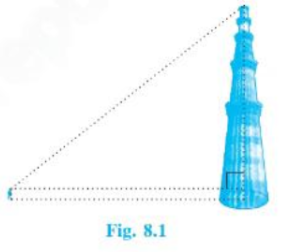
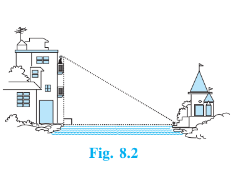
Right-triangle model: A line of sight, a horizontal distance, and a vertical height can form a right triangle.
Modern use: Trigonometric methods are used in engineering and physical sciences.
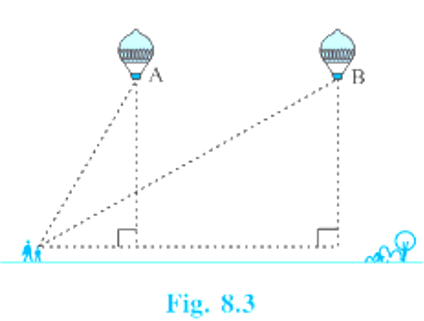
A tower viewed along a line of sight from a horizontal baseline.A line of sight across water illustrates a right-triangle setup for finding distance.Angles of elevation to two hot-air balloon positions form a trigonometry situation.
Naming the Sides of a Right Triangle
Definition
Trigonometric ratio — A ratio of two side lengths of a right triangle, defined with respect to one of its acute angles.
Side names depend on the chosen angle
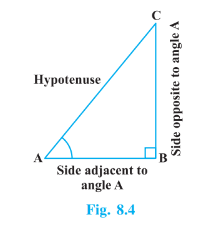
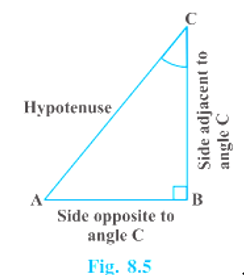
Hypotenuse: The side opposite the right angle; it is the longest side.
Opposite side: The side directly across from the chosen acute angle.
Adjacent side: The side next to the chosen angle that is not the hypotenuse.
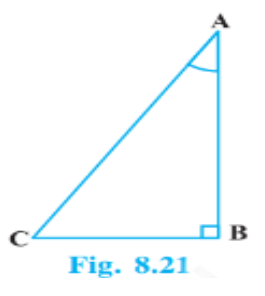
Changing the angle: In right triangle ABC with right angle at B, relative to angle A, BC is opposite and AB is adjacent; relative to angle C, these roles switch.
A right triangle labels the hypotenuse and the sides opposite and adjacent to angle A.The opposite and adjacent side labels change when angle C is chosen.
The Six Trigonometric Ratios
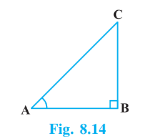
Ratios for an acute angle A in right triangle ABC (right angle at B)
Ratio
Definition using sides
Abbreviation
Sine
Opposite / hypotenuse
sinA=ACBC
Cosine
Adjacent / hypotenuse
cosA=ACAB
Tangent
Opposite / adjacent
tanA=ABBC
Cosecant
Hypotenuse / opposite
cosecA=BCAC
Secant
Hypotenuse / adjacent
secA=ABAC
Cotangent
Adjacent / opposite
cotA=BCAB
Reciprocal and quotient relationships
Cosecant, secant, and cotangent are reciprocals of sine, cosine, and tangent, respectively. Also, tangent is sine divided by cosine, and cotangent is cosine divided by sine.
Use the chosen angle to identify opposite and adjacent sides first.
Memory hook Prepzy tip
SOH–CAH–TOA
For sine, cosine, and tangent: Sine = Opposite/Hypotenuse; Cosine = Adjacent/Hypotenuse; Tangent = Opposite/Adjacent.
⚠ Common mistake
Do not treat sinA as the product of “sin” and A; it means the sine of angle A. Also, cosecA is not sin−1A: cosecant is the reciprocal of sine, while inverse sine is a different function.
Trigonometric Ratios Do Not Depend on Triangle Size
Invariance of trigonometric ratios
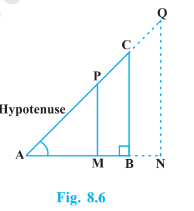
For a fixed acute angle, each trigonometric ratio has the same value in every right triangle containing that angle. The triangles are similar by the AA criterion, so corresponding side ratios are equal.
ABAM=ACAP=BCMP,APMP=ACBC=sinA
Similar right triangles formed using points on the same inclined line have equal trigonometric ratios for angle A.
Notation
Powers:sin2A means (sinA)2; similarly for other ratios.
Angle symbol: The Greek letter θ may be used to represent an angle.
Finding Other Ratios from One Given Ratio
Definition
Side-ratio method — A given trigonometric ratio fixes a proportion between two sides; use a convenient scale and the Pythagorean theorem to find the third side.
Pythagorean theorem
AC2=AB2+BC2
For the right triangle used here, the hypotenuse is AC.
Find all ratios from one known ratio
Translate the given ratio into a proportion between the relevant sides.
Choose convenient positive side lengths matching that proportion.
Use the Pythagorean theorem to find the remaining side.
Substitute the three side lengths into the six definitions.
Worked example
If sinA=31, find the other five trigonometric ratios of acute angle A.
Given sinA=31, so the opposite side and hypotenuse are in the ratio 1:3. Choose BC=k and AC=3k, where k>0.
ACBC=31,BC=k,AC=3k
Apply the Pythagorean theorem to find the adjacent side.
AB2=AC2−BC2=(3k)2−k2=8k2,AB=22k
Use the side lengths to calculate the remaining ratios.
Prove that if acute angles B and Q satisfy sinB=sinQ, then B=Q.
Suppose sinB=sinQ for acute angles B and Q. Write sine as opposite side over hypotenuse in each right triangle.
h1x=h2y
The equal ratios mean the opposite sides and hypotenuses have a common scale factor k.
h2h1=yx=k
By Pythagoras' theorem, the adjacent sides have the same scale factor.
h22−y2h12−x2=k
All corresponding sides are proportional, so the right triangles are similar and the corresponding angles are equal.
B=Q
Answer: Equal sine ratios, together with Pythagoras' theorem, make the corresponding right triangles similar. Therefore, B=Q.
Evaluating Expressions from Triangle Sides
Pythagorean Identity
sin2θ+cos2θ=1
For an acute angle in a right triangle, this follows by dividing Pythagoras' theorem by the hypotenuse squared.
Worked example
In a right triangle, the hypotenuse is 29 and the side adjacent to θ is 21. Find cos2θ+sin2θ and cos2θ−sin2θ.
The hypotenuse is 29 and the side adjacent to θ is 21. Find the opposite side.
p=292−212=(29−21)(29+21)=20
Write the sine and cosine values.
sinθ=2920,cosθ=2921
Evaluate the sum of the squares.
cos2θ+sin2θ=292212+202=1
Evaluate the difference of the squares.
cos2θ−sin2θ=292212−202=84141
Answer:1 and 84141, respectively.
Using a Given Tangent
Worked example
In a right triangle, if tanA=1, verify that 2sinAcosA=1.
Given tanA=1, take both legs to have length k.
opposite=adjacent=k
Find the hypotenuse using Pythagoras' theorem.
h=k2+k2=k2
Calculate sine and cosine.
sinA=k2k=21,cosA=k2k=21
Substitute into the required expression.
2sinAcosA=2(21)(21)=1
Answer:2sinAcosA=1.
Finding Sides from a Difference
Solve a right triangle from a difference condition
Represent the unknown leg by a variable and express the hypotenuse using the given difference.
Substitute into Pythagoras' theorem and solve for the unknown.
Use the resulting side lengths to calculate the requested ratios.
Worked example
In right triangle OPQ, right-angled at P, OP=7 cm and OQ−PQ=1 cm. Find sinQ and cosQ.
Let PQ=x cm. Since OQ−PQ=1 cm, OQ=x+1 cm; also OP=7 cm.
OQ=x+1
Apply Pythagoras' theorem and solve for x.
(x+1)2=x2+72⟹2x+1=49⟹x=24
Thus the hypotenuse is 25 cm. Relative to angle Q, the opposite side is OP and the adjacent side is PQ.
OQ=25
Calculate the required ratios.
sinQ=OQOP=257,cosQ=OQPQ=2524
Answer:sinQ=257 and cosQ=2524.
⚠ Common mistake
Do not swap the opposite and adjacent sides: identify them relative to the angle being considered. In the 29-unit triangle example, the corrected second expression is cos2θ−sin2θ.
Practice
If tanA=125, find the other five trigonometric ratios.
Hint: Use legs 5k and 12k, then find the hypotenuse.
Key step:h=(5k)2+(12k)2=13k.
Solution: The ratios are sinA=135, cosA=1312, cotA=512, cosecA=513, and secA=1213.
Practice
In a right triangle, the hypotenuse is 17 and the side opposite θ is 8. Find sinθ, cosθ, and cos2θ−sin2θ.
Hint: Find the adjacent side using Pythagoras' theorem.
Key step: The adjacent side is 172−82=15.
Solution:sinθ=178, cosθ=1715, and cos2θ−sin2θ=289161.
Practice
In a right triangle, one leg is 5 cm and the hypotenuse exceeds the other leg by 1 cm. Find the hypotenuse and the sine ratios of both acute angles.
Hint: Let the other leg be x; write the hypotenuse as x+1 and use Pythagoras' theorem.
Key step:(x+1)2=x2+25, so x=12 and the hypotenuse is 13.
Solution: The side lengths are 5, 12, and 13 cm. The two acute-angle sine ratios are 135 and 1312.
Quick recap
For an acute angle, sine and cosine are each strictly between 0 and 1.
A known trigonometric ratio fixes side proportions; use Pythagoras' theorem to find the third side.
For acute angles, sinB=sinQ implies B=Q.
For an acute angle in a right triangle, sin2θ+cos2θ=1.
If tanA=1, the legs are equal and 2sinAcosA=1.
Translate a stated side difference into an equation before applying Pythagoras' theorem.
In a right triangle whose acute angles are both 45∘, express the hypotenuse and the sine of an acute angle in terms of a leg a.
Let the two equal legs of an isosceles right triangle be a; find the hypotenuse and the sine of an acute angle.
AB=BC=a
Apply Pythagoras to find the hypotenuse.
AC=a2+a2=a2
Use opposite side divided by hypotenuse.
sin45∘=a2a=21
Answer: The hypotenuse is a2 and sin45∘=21.
Trigonometric ratios of 30° and 60°
Definition
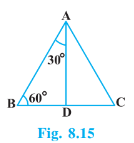
Trigonometric ratios of 30° and 60° — An altitude of an equilateral triangle bisects its base and forms right triangles with acute angles of 30∘ and 60∘.
An altitude of an equilateral triangle forms two congruent right triangles.
Deriving the 30°–60° ratios
For an equilateral triangle of side 2a, the altitude bisects the base into two lengths of a. Pythagoras gives the altitude as a3.