Class 10 . Mathematics . Mathematics . Circles
Chapter 10: Circles
Ch 10
Mathematics
Class 10
Introduction
Circle — A circle is the set of all points in a plane at a fixed distance, called the radius, from a fixed point, called the centre.
A Line and a Circle
Possible Positions
- No common point: The line is non-intersecting with respect to the circle.
- Two common points: The line is a secant; the points on the circle are the endpoints of a chord.
- One common point: The line is a tangent; the shared point is the point of contact.
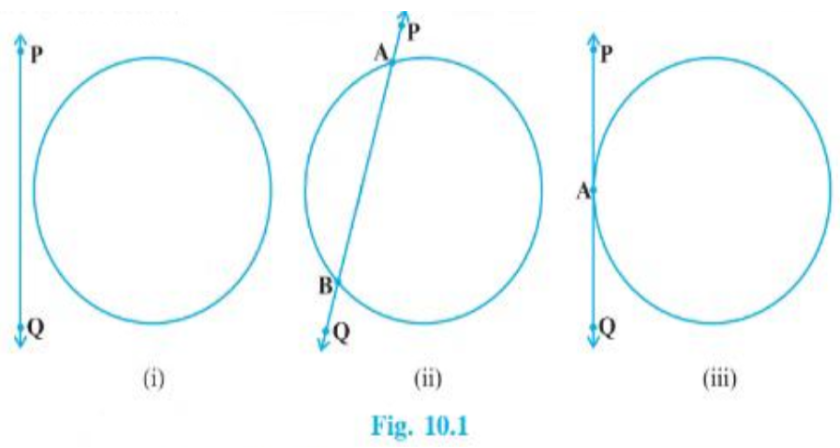
Tangent — A tangent is a line that meets a circle at exactly one point.
Tangent Facts
- Secant connection: A tangent is the limiting case of a secant when the two endpoints of the corresponding chord coincide.
- At a point: Exactly one tangent can be drawn to a circle at any given point on it.
- Parallel tangents: There can be at most two tangents to a circle parallel to a given secant.
- Everyday model: A rope touching a pulley, or the ground touching a wheel, can represent a tangent.
Radius and Tangent
The tangent at any point of a circle is perpendicular to the radius through the point of contact.
Use when a line is tangent at point to a circle with centre .
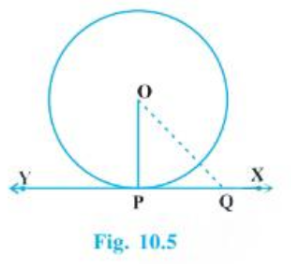
Why the Radius Is Perpendicular to the Tangent
- Let be tangent to the circle at , with centre ; choose any other point on .
- Since is not the point of contact, it lies outside the circle, so its distance from exceeds the radius.
- Thus is the shortest distance from to the line ; the shortest distance from a point to a line is perpendicular to it.
Related Term
- Normal: The line containing the radius through the point of contact is called the normal to the circle at that point.
A line touches a circle with centre at . Find the angle between and .
- A line touches a circle with centre at . Find the angle between and .
- The radius through the point of contact is perpendicular to the tangent.
- Therefore, the angle between them is a right angle.
A line cuts a circle at exactly two points. What is the line called?
A tangent touches a circle at . If is the centre, what is the angle between and the tangent?
What is the maximum number of tangents to a circle that can be parallel to a given secant?
Quick recap
- A line and a circle can have zero, one, or two common points.
- A line with one common point is a tangent; that point is the point of contact.
- A tangent is a limiting case of a secant when the chord endpoints coincide.
- There is exactly one tangent at any given point of a circle.
- The radius through the point of contact is perpendicular to the tangent.
- The radius line through the point of contact is also called the normal.
Number Of Tangents From A Point On A Circle
How Many Tangents Can Be Drawn?
Number of tangents from a point — The number of tangents from a point depends on whether it lies inside, on, or outside the circle.
| Position of point | Number of tangents | Reason |
|---|---|---|
| Inside the circle | 0 | Every line through the point intersects the circle at two points. |
| On the circle | 1 | There is exactly one tangent at the point of contact. |
| Outside the circle | 2 | Exactly two tangents can be drawn from the point. |
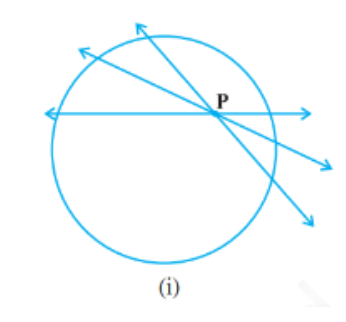
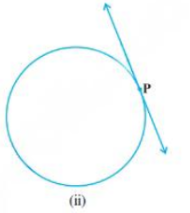
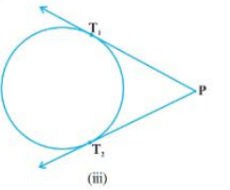
Equal Tangents from an External Point
The lengths of two tangents drawn from the same external point to a circle are equal. If tangents from touch the circle at and , then . Join the centre to , , and : and are radii perpendicular to the tangents. Thus right triangles and are congruent by RHS, so by CPCT.
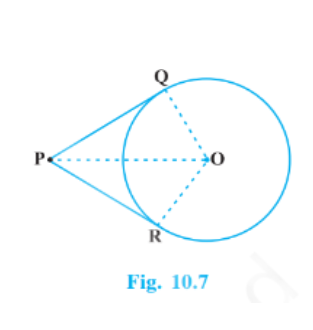
The line joining the external point to the centre bisects the angle between the two tangents.
Useful Consequences
- Equal tangent lengths: Tangents from the same external point are equal.
- Angle bisector: The centre-to-external-point line bisects the angle between the two tangents.
- Right triangle: For an external point , centre , radius , and tangent length , .
Solving Tangent-Length Problems
- Join the centre to the external point and to each point of contact.
- Use the perpendicular radius–tangent property to identify right triangles.
- Apply equal tangents, congruence, similarity, or Pythagoras as appropriate.
- Substitute the known lengths and solve for the required quantity.
A chord of length cm in a circle of radius cm has tangents at and meeting at . Find .
- A chord of length cm in a circle of radius cm has tangents at and meeting at . Find .
- Since the tangents from are equal, bisects the angle between them; hence it bisects chord at and is perpendicular to it.
- Use right triangle to find the distance from the centre to the chord.
- Triangles and are similar, so their corresponding sides are proportional.
- Solve for the tangent length.
Applications
Chord of a Larger Circle Touching a Concentric Smaller Circle
- Setup: Two circles share centre . A chord of the larger circle touches the smaller circle at .
- Perpendicular: is a radius to the point of contact, so .
- Conclusion: A perpendicular from the centre of a circle to a chord bisects the chord; therefore, .
For tangents and meeting at , \angle OPQ is the angle between and (not between a radius and a tangent).
Why the Angle Relation Holds
- Equal tangents: , so triangle is isosceles.
- Base angles: If \angle PTQ=\theta, then \angle TPQ=90^\circ-\frac{\theta}{2}.
- Radius and tangent: , so \angle OPT=90^\circ. Since \angle OPQ=\angle OPT-\angle TPQ, \angle OPQ=\frac{\theta}{2} and thus \angle PTQ=2\angle OPQ.
Two concentric circles have centre . A chord of the larger circle touches the smaller circle at . Prove that .
Tangents and are drawn from to a circle with centre . Prove that .
The equal-tangents theorem applies only to tangents drawn from the same external point. Also, \angle OPQ is between and ; the radius is perpendicular to tangent , not to chord .
Quick recap
- A point inside, on, or outside a circle has respectively , , or tangents.
- A tangent is perpendicular to the radius at the point of contact.
- Two tangent segments from the same external point are equal.
- The line from the centre to the external point bisects the angle between the tangents.
- A perpendicular from the centre to a chord bisects the chord.
- For tangents and , when are the contact points.
Formula sheet
Mathematics — ALL CHAPTERS
1
Real Numbers
2
Polynomials
3
Pair Of Linear Equations In Two Variables
4
Quadratic Equations
5
Arithmetic Progressions
6
Triangles
7
Coordinate Geometry
8
Introduction To Trigonometry
9
Some Applications Of Trigonometry
10
Circles
11
Areas Related To Circles
12
Surface areas And Volumes
13
Statistics
14
Probability