Class 10 . Mathematics . Mathematics . Real Numbers
Chapter 1: Real Numbers
Ch 1
Mathematics
Class 10
Introduction
Chapter Roadmap
Fundamental Theorem of Arithmetic
Fundamental Theorem of Arithmetic — Every composite number can be expressed as a product of primes, and this factorisation is unique apart from the order of the prime factors.
Writing the prime factors in ascending order gives one unique factorisation. Grouping equal primes gives a product of prime powers.
Key points and applications
- Prime factors can repeat; for example, and .
- Prime powers are a compact way to write repeated factors, such as .
- Applications include checking divisibility, finding HCF and LCM, proving certain roots irrational, and analysing rational-number decimal expansions from the denominator’s prime factors.
- Prime supply is infinite, so primes and their products generate infinitely many positive integers.
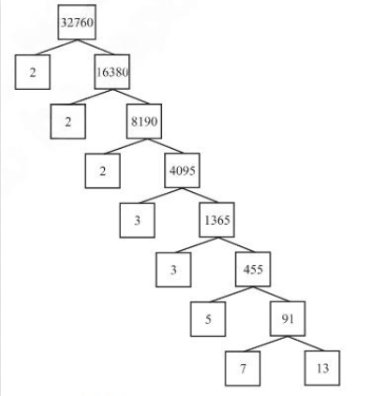
Prime factorisation
- Break the number into factors until every factor is prime.
- Write all prime factors in ascending order, then combine repeated primes as powers.
Find the prime factorisation of 32760.
- Factorise 32760 by splitting it into convenient factors.
- Continue factoring each part until only primes remain.
- Collect equal prime factors as powers.
Using Prime Factors to Find HCF and LCM
Prime-factorisation method — A method for finding HCF and LCM by comparing the prime powers in the numbers’ factorizations.
For the HCF, take the smallest exponent of each prime common to all the numbers. For the LCM, take the greatest exponent of every prime appearing in any of them.
Use this to find either the HCF or LCM once the other is known.
Find HCF and LCM by prime factorisation
- Write each number as a product of prime powers.
- For the HCF, multiply the smallest powers of the primes common to every number.
- For the LCM, multiply the greatest powers of all primes present.
Find the HCF and LCM of 6 and 20 using prime factorisation.
- Write 6 and 20 as prime powers.
- The only shared prime is 2; use its smallest exponent for the HCF.
- Use the greatest exponent of every prime present for the LCM.
- Check the two-number product relation.
Important applications and limits
- Ending in zero: A number ending in is divisible by ; its prime factorisation must therefore contain .
- Powers of 4: Since contains only the prime , no natural-number power of ends in .
- Two numbers: The HCF–LCM product relation applies to any pair of positive integers.
- Three or more numbers: In general, the product of all the numbers is not equal to their HCF multiplied by their LCM.
Do not use the smallest exponent of every prime for the HCF: only primes common to all numbers contribute. The HCF–LCM product identity is guaranteed for two numbers, not generally for three or more.
Can end in the digit for any natural number ?
Find the HCF and LCM of and using prime factorisation.
Find the HCF and LCM of , and by prime factorisation.
Quick recap
- Euclid’s division algorithm writes with and helps find HCF.
- Every composite number has a unique prime factorisation, except for the order of its factors.
- The HCF uses the smallest powers of primes common to all numbers; the LCM uses the greatest powers of all primes present.
- For two positive integers, .
- A power of cannot end in because its prime factorisation contains no factor .
- Prime factorisation can help prove irrationality and determine the decimal form of rational numbers.
Revisiting Irrational Numbers
Irrational Numbers and Prime Factorisation
Irrational number — A real number is irrational if it cannot be written as , where and are integers and .
Examples and real numbers
- Examples: are irrational.
- Decimal example: is non-terminating and non-repeating.
- Real numbers: Rational and irrational numbers together form the real numbers.
Every composite number has a prime factorisation, unique apart from the order of its prime factors.
A Prime Dividing a Square
If is prime and , then , for a positive integer . Prime factorisation shows that the prime factors of come from those of .
If , then each prime factor appears twice in .
Proving Square Roots of Primes Are Irrational
For every prime , is irrational. If we assume in lowest terms, then forces to divide both and , contradicting that they are coprime.
Proof by contradiction for
- Assume the opposite and write the root as a reduced fraction, with .
- Square and rearrange; the prime divisor property implies .
- Write and substitute; this implies as well.
- Since and share the factor , this contradicts their being coprime; conclude the root is irrational.
Prove that is irrational.
- Assume, for contradiction, that in lowest terms, where .
- Squaring gives . Thus , so ; write .
- Substitute ; then , so .
- Both and are divisible by , contradicting that they are coprime.
When assuming a number is rational for a contradiction proof, write it as a fraction in lowest terms before deriving divisibility.
Operations with Rational and Irrational Numbers
The sum or difference of a rational and an irrational number is irrational. The product of a non-zero rational and an irrational number is irrational; dividing an irrational number by a non-zero rational also gives an irrational number.
Show an expression is irrational
- Assume the expression is rational.
- Rearrange or divide by a non-zero rational to make a known irrational number rational.
- The contradiction proves that the original expression is irrational.
Illustrations
- Difference: If were rational, then would be rational, a contradiction.
- Product: If were rational, then dividing by would make rational, a contradiction.
HCF and LCM of Three Numbers
- Three numbers: For positive integers , the product of their HCF and LCM is not generally equal to .
- Example: For , the HCF is and the LCM is , so their product is , whereas .
Prove that is irrational.
Show that is irrational.
Show that is irrational.
- Prime-root result: is irrational whenever is prime.
- Contradiction pattern: Assume a reduced fraction, force a prime to divide both numerator and denominator, then reject the assumption.
- Operation shortcut: Assume the target expression is rational and rearrange to contradict a known irrationality.
Quick recap
- An irrational number cannot be expressed as a ratio of integers with a non-zero denominator.
- Unique prime factorisation implies that if a prime divides a square, it divides the original integer.
- Assuming is a reduced fraction forces the prime to divide both numerator and denominator.
- Therefore, and are irrational; the proof applies to every prime .
- Adding or subtracting a rational number from an irrational number gives an irrational number.
- Multiplying an irrational number by a non-zero rational number, or dividing it by one, gives an irrational number.
- For three positive integers, HCF times LCM is not generally equal to their product.
Formula sheet
Mathematics — ALL CHAPTERS
1
Real Numbers
2
Polynomials
3
Pair Of Linear Equations In Two Variables
4
Quadratic Equations
5
Arithmetic Progressions
6
Triangles
7
Coordinate Geometry
8
Introduction To Trigonometry
9
Some Applications Of Trigonometry
10
Circles
11
Areas Related To Circles
12
Surface areas And Volumes
13
Statistics
14
Probability