Class 10 . Mathematics . Mathematics . Quadratic Equations

Chapter 4: Quadratic Equations

Ch 4

Mathematics

Class 10

Lecture 1

Introduction & Quadratic Equations

Reference video Β· Lecture 1Introduction & Quadratic Equations

Meaning and Standard Form

Standard form
ax2+bx+c=0,a≠0ax^2+bx+c=0,\qquad a\ne 0

Use this form to identify whether an equation is quadratic.

Worked example

Write 4xβˆ’3x2+2=04x-3x^2+2=0 in standard form and identify its coefficients.

  1. Rewrite the equation in descending powers of the variable.
    4xβˆ’3x2+2=0βŸΉβˆ’3x2+4x+2=04x-3x^2+2=0\quad\Longrightarrow\quad -3x^2+4x+2=0
  2. Compare with the standard form and identify the coefficients.
    a=βˆ’3,b=4,c=2a=-3,\qquad b=4,\qquad c=2
Answer: The standard form is βˆ’3x2+4x+2=0-3x^2+4x+2=0, so a=βˆ’3a=-3, b=4b=4, and c=2c=2. Since aβ‰ 0a\ne0, it is quadratic.

Forming Quadratic Equations from Situations
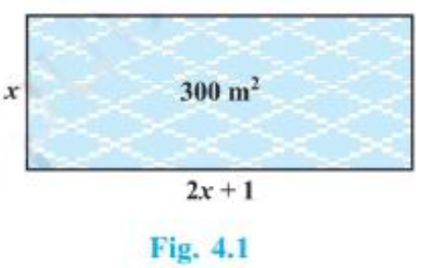
Rectangular prayer hall: breadth x m, length 2x+1 m, and area 300 mΒ².
Rectangular prayer hall: breadth xx m, length 2x+12x+1 m, and area 300Β m2300\text{ m}^2.
Area-based equation
Area=lengthΓ—breadth\text{Area}=\text{length}\times\text{breadth}

For a rectangle, area equals length multiplied by breadth; substitute the expressions given in the situation.

Worked example

A rectangular hall has area 300Β m2300\text{ m}^2 and its length is one metre more than twice its breadth. Form a quadratic equation for its breadth.

  1. Let the breadth be xx metres; express the length using the given condition.
    breadth=x,length=2x+1\text{breadth}=x,\qquad \text{length}=2x+1
  2. Use the area condition to form an equation.
    x(2x+1)=300x(2x+1)=300
  3. Expand and rearrange into standard form.
    2x2+x=300⟹2x2+xβˆ’300=02x^2+x=300\quad\Longrightarrow\quad 2x^2+x-300=0
Answer: The required equation is 2x2+xβˆ’300=02x^2+x-300=0.
Practice

Together, John and Jivanti initially have 4545 marbles. Each loses 55, and the product of their remaining marbles is 124124. If John initially had xx, form the quadratic equation.

Hint: Jivanti initially has 45βˆ’x45-x marbles.
Key step: (xβˆ’5)(40βˆ’x)=124(x-5)(40-x)=124
Solution: Expand and rearrange: (xβˆ’5)(40βˆ’x)=124β‡’βˆ’x2+45xβˆ’324=0(x-5)(40-x)=124\Rightarrow -x^2+45x-324=0, hence x2βˆ’45x+324=0x^2-45x+324=0.
Practice

A workshop makes xx toys in a day. Each toy costs Rs. 55βˆ’x55-x to produce, and the total cost is Rs. 750750. Form the quadratic equation.

Hint: Total cost is number of toys multiplied by cost per toy.
Key step: x(55βˆ’x)=750x(55-x)=750
Solution: x(55βˆ’x)=750β‡’55xβˆ’x2=750β‡’x2βˆ’55x+750=0x(55-x)=750\Rightarrow 55x-x^2=750\Rightarrow x^2-55x+750=0.

Checking Whether an Equation Is Quadratic

Classify an equation

  1. Expand brackets and simplify each side.
  2. Bring all terms to one side and combine like terms.
  3. Check whether the resulting equation has degree 22 and a non-zero quadratic coefficient.
    ax2+bx+c=0,a≠0ax^2+bx+c=0,\qquad a\ne0
Examples: simplify before classifying
Given equationSimplified formQuadratic?
(xβˆ’2)2+1=2xβˆ’3(x-2)^2+1=2x-3x2βˆ’6x+8=0x^2-6x+8=0Yes
x(x+1)+8=(x+2)(xβˆ’2)x(x+1)+8=(x+2)(x-2)x+12=0x+12=0No; it is linear
x(2x+3)=x2+1x(2x+3)=x^2+1x2+3xβˆ’1=0x^2+3x-1=0Yes
(x+2)3=x3βˆ’4(x+2)^3=x^3-4x2+2x+2=0x^2+2x+2=0Yes
Worked example

Check whether (x+2)3=x3βˆ’4(x+2)^3=x^3-4 is a quadratic equation.

  1. Expand the cube on the left.
    (x+2)3=x3+6x2+12x+8(x+2)^3=x^3+6x^2+12x+8
  2. Cancel matching cubic terms and move all terms to one side.
    x3+6x2+12x+8=x3βˆ’4⟹6x2+12x+12=0x^3+6x^2+12x+8=x^3-4\quad\Longrightarrow\quad 6x^2+12x+12=0
  3. Divide by the common factor and identify the degree.
    x2+2x+2=0x^2+2x+2=0
Answer: It reduces to x2+2x+2=0x^2+2x+2=0, so it is quadratic.
Practice

Is x(x+1)+8=(x+2)(xβˆ’2)x(x+1)+8=(x+2)(x-2) a quadratic equation?

Hint: Expand both sides and cancel matching terms.
Key step: x2+x+8=x2βˆ’4x^2+x+8=x^2-4
Solution: x+12=0x+12=0, which is linear; therefore, it is not quadratic.
⚠ Common mistake

Do not classify an equation by its original appearance alone. Simplify first: terms of degree 22 or higher may cancel, changing the equation's final degree.

Quick recap

  • A quadratic equation has standard form ax2+bx+c=0ax^2+bx+c=0, with aβ‰ 0a\ne0.
  • The equation's degree must be checked after simplification.
  • To model a situation, define the unknown, write the relationships, and rearrange into standard form.
  • For rectangle problems, use area == length Γ—\times breadth.
  • Quadratic terms can cancel, while higher-degree terms can also cancel and leave a quadratic equation.
Lecture 2

Solution Of A Quadratic Equation By Factorisation

Reference video Β· Lecture 2Solution Of A Quadratic Equation By Factorisation

Roots and Factorisation

Definition

Root of a quadratic equation — A real number α\alpha is a root of ax2+bx+c=0ax^2+bx+c=0 if aα2+bα+c=0a\alpha^2+b\alpha+c=0, where a≠0a\ne 0.

Roots and zeroes

The roots of ax2+bx+c=0ax^2+bx+c=0 are exactly the zeroes of the quadratic polynomial ax2+bx+cax^2+bx+c. A quadratic equation has at most two roots.

Zero-product property

If a product is zero, at least one factor is zero: AB=0AB=0 implies A=0A=0 or B=0B=0. Use this after factorising the quadratic.

Splitting the middle term
m+n=b,mn=acm+n=b,\qquad mn=ac

For ax2+bx+cax^2+bx+c, choose m,nm,n such that m+n=bm+n=b and mn=acmn=ac, then group and factor.

Solve by factorisation

  1. Write the equation in the form ax2+bx+c=0ax^2+bx+c=0.
    ax2+bx+c=0ax^2+bx+c=0
  2. Find two terms whose sum is the middle-term coefficient and whose product is acac; split the middle term.
    m+n=b,mn=acm+n=b,\qquad mn=ac
  3. Group terms and factorise into two linear factors.
    ax2+bx+c=(px+q)(rx+s)ax^2+bx+c=(px+q)(rx+s)
  4. Set each factor equal to zero and solve the resulting linear equations.
    (px+q)(rx+s)=0β‡’px+q=0Β orΒ rx+s=0(px+q)(rx+s)=0\Rightarrow px+q=0\text{ or }rx+s=0
Worked example

Find the roots of 6x2βˆ’xβˆ’2=06x^2-x-2=0 by factorisation.

  1. Solve 6x2βˆ’xβˆ’2=06x^2-x-2=0 by splitting the middle term.
    6x2βˆ’xβˆ’2=06x^2-x-2=0
  2. Split βˆ’x-x as 3xβˆ’4x3x-4x, since the terms add to βˆ’x-x and their product is βˆ’12x2-12x^2.
    6x2+3xβˆ’4xβˆ’2=06x^2+3x-4x-2=0
  3. Factor by grouping.
    3x(2x+1)βˆ’2(2x+1)=0β‡’(3xβˆ’2)(2x+1)=03x(2x+1)-2(2x+1)=0\Rightarrow(3x-2)(2x+1)=0
  4. Set each factor to zero and solve.
    3xβˆ’2=0β‡’x=23,2x+1=0β‡’x=βˆ’123x-2=0\Rightarrow x=\frac{2}{3},\qquad 2x+1=0\Rightarrow x=-\frac{1}{2}
Answer: The roots are 23\frac{2}{3} and βˆ’12-\frac{1}{2}.
⚠ Common mistake

Do not divide by a factor that contains the variable; set each factor equal to zero so no root is lost.

Nature of Roots

Definition

Discriminant β€” For ax2+bx+c=0ax^2+bx+c=0, the discriminant D=b2βˆ’4acD=b^2-4ac determines the number and type of real roots.

Discriminant and nature of roots
DiscriminantNature of roots
D>0D>0Two distinct real roots
D=0D=0Two equal (coincident) real roots
D<0D<0No real roots
Quadratic formula
x=βˆ’bΒ±b2βˆ’4ac2ax=\frac{-b\pm\sqrt{b^2-4ac}}{2a}

Use to find the roots directly; for real roots, the condition is Dβ‰₯0D\ge 0.

Determine the nature of roots

  1. Identify aa, bb, and cc in standard form.
    ax2+bx+c=0ax^2+bx+c=0
  2. Calculate the discriminant.
    D=b2βˆ’4acD=b^2-4ac
  3. Use the sign of DD to classify the roots.
    D>0:Β distinctΒ real;D=0:Β equalΒ real;D<0:Β noΒ realΒ rootsD>0:\text{ distinct real};\quad D=0:\text{ equal real};\quad D<0:\text{ no real roots}
Worked example

Find the discriminant and nature of the roots of 2x2βˆ’4x+3=02x^2-4x+3=0.

  1. Find the discriminant and nature of roots of 2x2βˆ’4x+3=02x^2-4x+3=0.
    a=2,b=βˆ’4,c=3a=2,\quad b=-4,\quad c=3
  2. Calculate the discriminant.
    D=(βˆ’4)2βˆ’4(2)(3)=16βˆ’24=βˆ’8D=(-4)^2-4(2)(3)=16-24=-8
  3. Since the discriminant is negative, there are no real roots.
    D=βˆ’8<0D=-8<0
Answer: The discriminant is βˆ’8-8, so the equation has no real roots.

Applying Quadratic Equations

Choosing a meaningful root

  • Applications: Form an equation from the situation, solve it, then reject roots that are not meaningful (for example, a negative distance or breadth).
  • Geometry: If a triangle is inscribed in a circle with one side as the diameter, the angle opposite the diameter is a right angle; Pythagoras’ theorem can then form the quadratic equation.
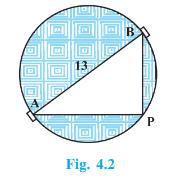
A triangle inscribed in a circle, with a diameter and labelled points.
Practice

A hall has breadth xx m, where 2x2+xβˆ’300=02x^2+x-300=0. Find its breadth and length if the length is 2x+12x+1 m.

Hint: Factorise the quadratic and keep the positive value of the breadth.
Key step: (xβˆ’12)(2x+25)=0(x-12)(2x+25)=0.
Solution: x=12x=12 or x=βˆ’12.5x=-12.5. Reject the negative breadth, so the breadth is 1212 m and the length is 2(12)+1=252(12)+1=25 m.
Practice

A circular park has diameter 1313 m. A pole on its boundary is 77 m farther from one of two diametrically opposite gates than from the other. Is this possible, and what are its distances from the gates?

Hint: Let the shorter distance be xx; use the right triangle formed by the two gates and the pole.
Key step: (x+7)2+x2=132(x+7)^2+x^2=13^2, so x2+7xβˆ’60=0x^2+7x-60=0.
Solution: The discriminant is 289289, and x=βˆ’7Β±172x=\frac{-7\pm17}{2} gives x=5x=5 or βˆ’12-12. Reject the negative distance: it is possible, with distances 55 m and 1212 m from the gates.
Practice

Find the nature and roots of 3x2βˆ’26x+2=03x^2-2\sqrt{6}x+2=0.

Hint: Check the discriminant, then solve the repeated linear factor.
Key step: D=(βˆ’26)2βˆ’4(3)(2)=0D=(-2\sqrt{6})^2-4(3)(2)=0.
Solution: The roots are equal. Since 3x2βˆ’26x+2=(3xβˆ’2)23x^2-2\sqrt{6}x+2=(\sqrt{3}x-\sqrt{2})^2, the repeated root is x=23x=\sqrt{\frac{2}{3}}.

Quick recap

  • A root makes the quadratic polynomial equal to zero; a quadratic has at most two roots.
  • Factorise the quadratic and set each linear factor equal to zero.
  • For middle-term splitting, choose terms with sum bb and product acac.
  • The discriminant is D=b2βˆ’4acD=b^2-4ac.
  • D>0D>0 gives two distinct real roots, D=0D=0 gives equal real roots, and D<0D<0 gives no real roots.
  • In applications, reject roots that cannot represent the quantity, such as negative lengths or distances.

Formula sheet

Standard form
ax2+bx+c=0,a≠0ax^2+bx+c=0,\qquad a\ne 0
Area-based equation
Area=lengthΓ—breadth\text{Area}=\text{length}\times\text{breadth}
Splitting the middle term
m+n=b,mn=acm+n=b,\qquad mn=ac
Quadratic formula
x=βˆ’bΒ±b2βˆ’4ac2ax=\frac{-b\pm\sqrt{b^2-4ac}}{2a}

Mathematics β€” ALL CHAPTERS

1

Real Numbers

View

2

Polynomials

View

3

Pair Of Linear Equations In Two Variables

View

4

Quadratic Equations

View

5

Arithmetic Progressions

View

6

Triangles

View

7

Coordinate Geometry

View

8

Introduction To Trigonometry

View

9

Some Applications Of Trigonometry

View

10

Circles

View

11

Areas Related To Circles

View

12

Surface areas And Volumes

View

13

StatisticsΒ 

View

14

Probability

View
Quadratic Equations Notes – Class 10 Mathematics | Prepzy